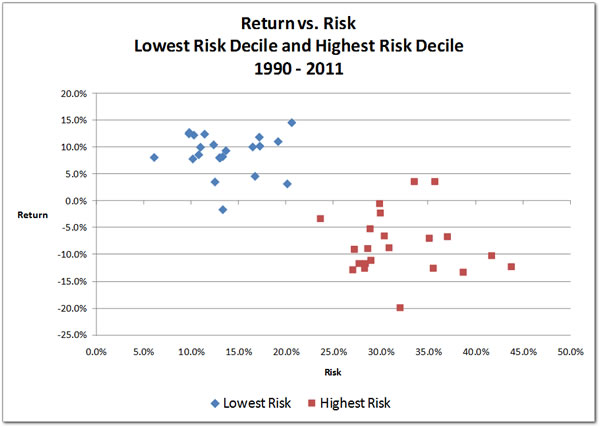
For decades, textbook finance taught that investors are paid for taking more risk. A body of research stretching back to the 1970s argues the opposite: across many markets and periods, shares with steadier prices have often delivered returns as good as, or better than, the most erratic ones. This pattern is called the low volatility anomaly.
Where the idea came from
Financial economist Robert A. Haugen and his coauthor A. James Heins first reported a negative link between risk and return in the early 1970s. Later studies, including a 2012 paper by Nardin Baker and Haugen covering 1990 to 2011, examined the same question in markets around the world. The chart above is drawn from that work. See the author background.
What this site covers
- Research summaries of academic papers on the volatility effect.
- A glossary of terms such as beta, variance and Sharpe ratio.
- A questions and answers page on how volatility is measured.
- Lists of funds and media coverage.
This material is general education, not investment advice, and past results do not guarantee future ones.